
Open a GIMP .xcf file on a computer without GIMP
Open a GIMP .xcf file in a browser tab with Madosuite Photo, on a Chromebook or a locked-down laptop, then save it as PSD, OpenRaster or PNG.
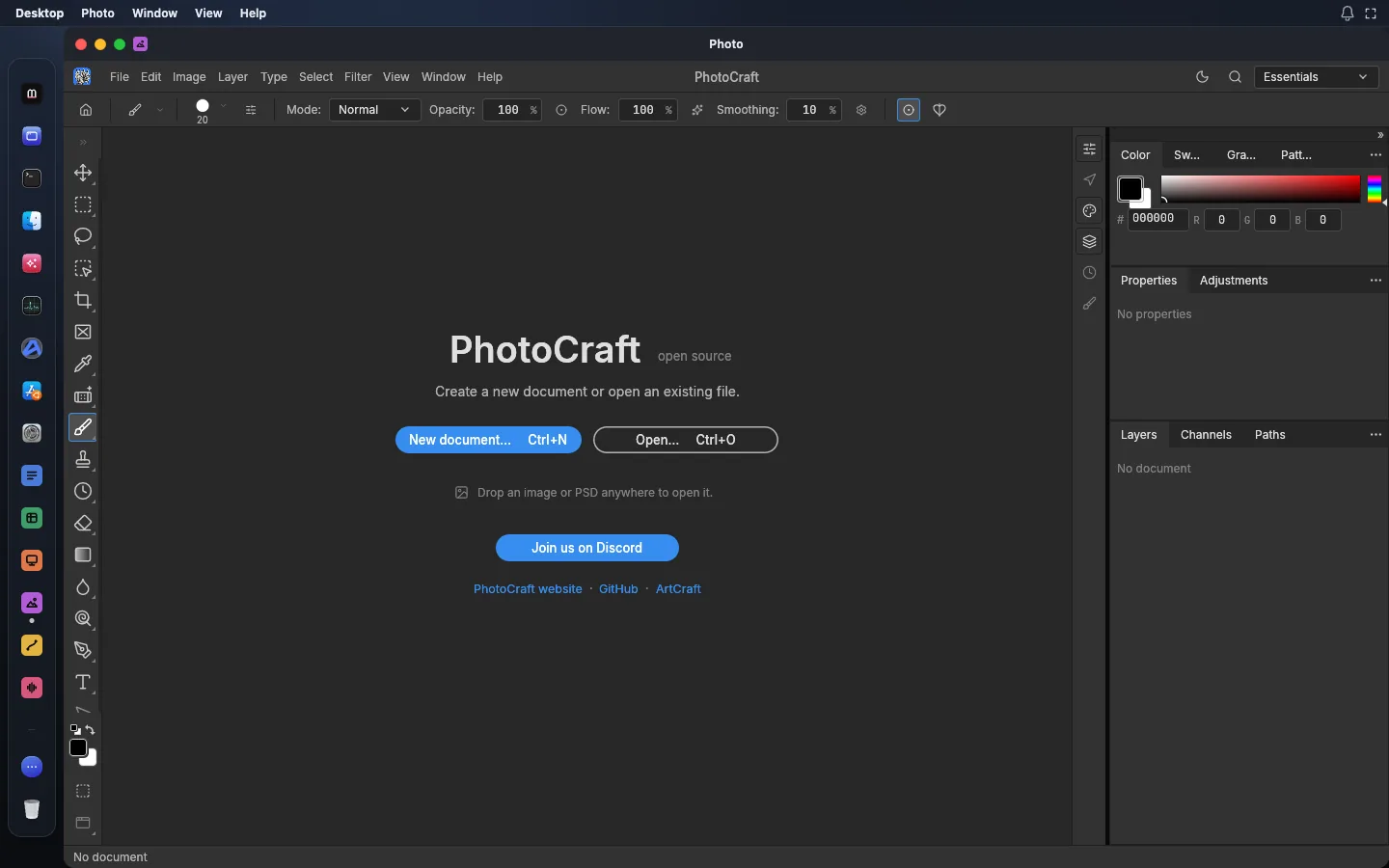
You can open a GIMP .xcf file on a computer that has no GIMP: open it in Photo, the image editor in Madosuite, which runs in a browser tab. Photo reads the file’s layers, groups, masks, blend modes, channels and the saved selection.
Here is how to do it, and how to hand the work on in a format the next person can use.
When you have an XCF and no GIMP
.xcf is GIMP’s own format. It keeps everything GIMP knows about an image, so it is what people send when they want you to keep editing. The trouble starts on the other end:
- You are on a Chromebook, where installing desktop software is not the usual path.
- You are on a work laptop where you cannot install anything.
- You are on a borrowed or shared computer and only need the file once.
In each case you have a browser. That is enough for Madosuite.
Why open it in Madosuite
- A desktop in a tab. Madosuite is a free desktop of apps in a browser tab, with windows, a dock and Files.
- The file stays on your device. Madosuite runs a Linux machine in your browser. Your file goes into its home folder in the browser. It is not uploaded to us.
- No account. Signing in with 0cloud is optional.
One thing to know on a shared computer: your files live in the browser’s site data. Clearing the site’s data deletes them. Download what you need before you leave.
How to open an XCF file
- Go to madosuite.com and open the desktop.
- Open Files from the dock.
- Press Upload and pick your
.xcffile. - Open it with Photo.
- Check the Layers panel. Layer groups, layer masks and blend modes come in as they were. Saved channels and the selection come in too.
Save it in a format you can use
Photo reads XCF but does not write it. Choose a save format by who gets the file next:
- PSD. For someone who works in Photoshop, or for you, if you will keep editing in Photo. Layers stay layers. See XCF to PSD.
- OpenRaster (.ora). To send layered work back to a GIMP user. Photo reads and writes OpenRaster with layers, groups and blend modes, and the format is meant for GIMP, Krita and MyPaint.
- PNG, JPEG, WebP or TIFF. For a flat picture. Quick Export makes a PNG in one step. Export As lets you pick format, quality, transparency and scale, with a preview and a file-size estimate.
After you save, open Files and download the result.
Work on it while it is open
Photo is a layered editor, so you can do real work on the file:
- Use selections, including Quick Selection, Object Selection and Select Subject. Smart selection runs on your device.
- Add adjustment layers such as Curves, Levels or Hue/Saturation, and mask them to one area.
- Add or edit type on its own layer.
- Undo any step from the History panel.
What may not carry over
Know the limits before you send the result.
- Only what Photo reads. Its documentation lists layers, groups, masks, blend modes, channels and the selection for XCF. Anything else GIMP stores in the file is not on that list. Compare with a PNG from the sender if something looks off.
- No XCF saving. Send OpenRaster or PSD back instead.
- Early alpha. Photo’s own documentation says “it is not yet a Photoshop replacement for daily professional work”. There are no AI or generative features, some tools are missing, and plug-ins do not run.
- Bit depth. JPEG and WebP are 8-bit. Exporting a 16-bit or 32-bit image to them reduces the depth, and Photo warns you. PNG keeps 16-bit; TIFF keeps up to 32-bit float.
Keep the original .xcf as the master copy.
Related
Start with the app on the Photo page.